


Hard Work VS Talent In Soccer Explained: 13 Tips to Train Smarter
What is more important in soccer, hard work or natural talent? You hear phrases like this all the time, “no pain, no gain” “Hard work beats talent when talent doesn’t work hard” and many other quotes that praise the importance of hard work.
Hard work in soccer, and everything else you do off the field, is obviously very important, but hard work is the bare minimum because everybody should be working hard already. For the most part, all serious players will claim they work hard, and they might, but only a small percentage actually build the natural talent needed to play at a high level.
What truly helps a player stand out is their unique talent which is based on their physical, mental, and technical skills. This talent is developed through optimal training environments during a player’s years from childhood to adulthood, requiring not only dedication and effort, but also smart training methods both on and off the field.
As an aspiring soccer player you have to realize that every single elite player has natural talent. Talent is what makes all the difference in the game, it is what makes players sought after by top clubs, and it determines their market value in the transfer window.
I’ve been playing soccer ever since I can remember, and growing up, I was always working really hard but when I faced real competition, I was not able to keep up or let my talents shine. It wasn’t until I discovered how to actually train as a soccer player in a smarter way, which involves training the key aspects of player development, talent, game IQ, mindset, athleticism, fitness, recovery, and discipline, consistently over a long period of time.
In this blog post, I will discuss the main difference between hard work and talent, and explain which is more important when trying to become a better soccer player and/or get in better shape.
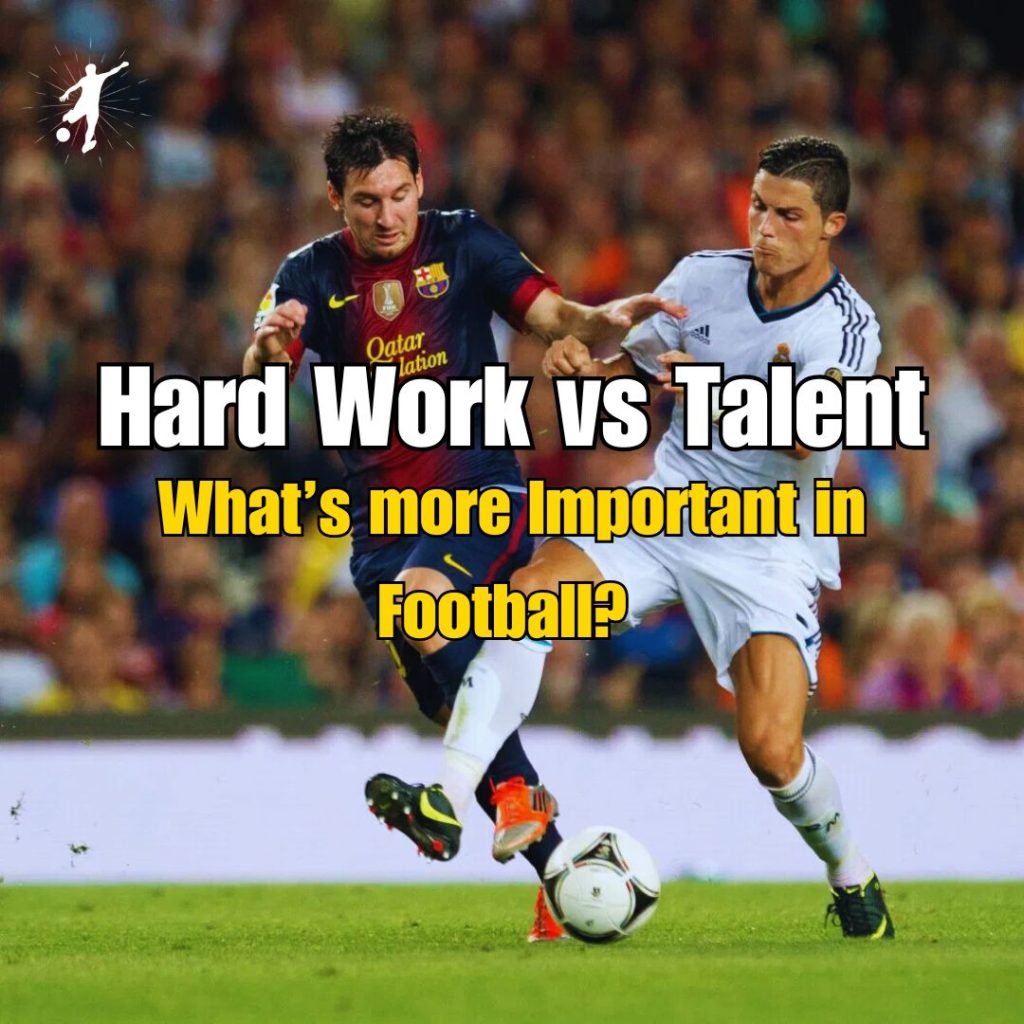
What is More Important in Soccer, Hard Work or Talent?
When talking about hard work vs talent, you have to understand that one is not better than the other. You need to have both, but where people go wrong with this topic is that most players think that just by working hard, they will develop their talent, which is not true.
As an aspiring player you have to understand that at the top level all of these players work hard, or worked hard to get to the top, and they are also very naturally talented. Talent is by far the most important trait in soccer because your unique talent is what’s going to make you stand out from the thousands of other players, its not your work ethic that is going to make you stand out.
With the quote “Hard work beats talent when talent doesn’t work hard” the truth is it depends and it can go both ways. For example, someone like Eden Hazard, who many teammates considered lazy, was probably outworked by a large percentage of players, but no one had the same amount of talent as him which is what made him so special.
As he climbed his way to the top, to develop all that talent, he was working hard, and eventually many could argue his poor work ethic caught up to him during his time at Real Madrid, which is where the balance between talent and hard work becomes so important. You can get by on raw talent alone for so long before consistent effort becomes necessary to maintain or improve that talent at the highest levels.
The same goes with Neymar, Ronaldinho, etc. Their talent is what made them become icons of the game, not their work ethic, but eventually their inconsistent work ethic did limit their longevity and prevent them from reaching their absolute peak potential.
Then there is another example like Carlos Vela, one of the best Mexican players of all time who claimed he liked basketball more and barely even cared for soccer. This guy was so naturally talented at the game that he became one of the best players in Mexican soccer, while millions of other players were working way harder than him, and actually liked the sport.
Of course then you also do have examples of players who have both talent and high work ethic, like the obvious one, Cristiano Ronaldo, but the point is that talent is the foundation. Without talent, even the hardest work will only take you so far in the game and vice versa, without hard work, your talent will only take you so far.
Hard work is good, because your competition is working hard too, but what is even better is smart work that directly improves your talent which ultimately is what will help you stand out on the field.
Hard Work Vs Smart Work
Now that we have settled that talent is more important than hard work, although they are both important, it is crucial to discuss the difference between smart work and hard work, which is what actually helps build your talent in the first place.
The reality is that anybody can train hard. Training hard is actually easy because you can do anything challenging that will get your heart rate up and give you that feeling of “Yes, I am training hard.”
Training hard can clearly have positives like improving your fitness, physical attributes and appearance, but training smart, which means training the right things, can directly help you improve your talent. Training smart and training the right things that matter to you and your role on the soccer field, and that you will actually have to use during a real game, is much better for your time and development than mindlessly working hard for the sake of being able to say “I am working hard.”
This is a good analogy for this. If you were in the middle of the ocean, only had a few hours left to survive, and you got the chance to choose between knowing which way to row to safety or be able to row faster, which one would you choose?
The correct answer should be knowing which way to row the boat because if you are rowing the wrong way, it doesn’t matter how fast or hard you row – you’ll never reach safety. This same principle applies to soccer training: working smart and in the right direction will always be more valuable than simply working hard without purpose.
How do you Train Smarter as a Soccer Player to Develop your Talent ?
Smart training in soccer means prioritizing improving the things that you will actually need to stand out during a real game, which includes the key pillars of player development as well as gaining mastery in the fundamental skills of the game, including decision making, awareness, composure, first touch, passing, dribbling, shooting, and defending.
In this section, I’ll provide practical tips to help you train smarter as a soccer player and achieve greater long-term success in the game. The most important thing when following these tips is discipline and consistency over a long period of time because smart training only works when it becomes a sustainable habit instead of a short-term effort.
- Develop a Real Passion For the Game
- Write Down Your Goals and Track Progress
- Find your unique talent
- Understand the game tactically
- Develop a strong growth mindset
- Improve your fitness and athleticism by training barefoot, improving your fascia system, and breathing mechanics
- Play the Game, and variations of the game, a lot
- Train with a team or group, but also spend time doing extra individual training when necessary
- Find the best team or league in your area, aim to become the best player there, and move on to a better team
- Cross Train with other sports
- Get out of your comfort zone
- Analyze your Soccer Games and Professional Soccer Games
- “Train” every other part of your life that affects performance and recovery
- Sleep
- Nutrition
- Hydration
- Light environment
- Non-Native EMF Protection
- Spending time in nature
- Supplementation
- Mitochondrial Function
Final Thoughts
The debate between hard work vs talent in soccer ultimately comes down to understanding that while natural talent provides the foundation for becoming an elite player, it must be combined with a smart, deliberate practice in soccer skill development, physical training, mental training, and recovery to achieve long term success. Young players who focus on developing both their innate ability and work ethic through smart training will have a better chance of reaching their full potential, whether that’s playing college soccer, joining a national team, or becoming a professional athlete.
Remember that even the best players of all time like Lionel Messi and Cristiano Ronaldo needed both exceptional natural abilities and a high work ethic, although most people nowadays classify Ronaldo as a “hard-worker” and Messi as a “natural talent”, which is not the case at all. They are both extremely talented and hard working.
FAQs
How do I raise my IQ in soccer?
Improving your soccer IQ comes from playing the game, getting high quality coaching, consistently analyzing professional games, studying different tactical systems, and understanding why certain decisions are made in specific game situations. The more you play, watch high-level soccer, and understand the game, the faster your decision-making and game intelligence will develop.
How do I improve my work ethic in soccer?
Building a strong work ethic in soccer starts with setting clear, specific goals and creating a structured training routine that you commit to following regardless of how you feel on any given day. The key is to focus on consistency over intensity, showing up every day and putting in quality work, even when you don’t feel like it to build the discipline needed for long-term success.
Are some soccer players born naturally talented?
Yes, some players are absolutely born with more natural talent than other, not just in soccer, but all types of sports. However, this raw talent must still be developed through proper training, recovery, coaching, and experience to reach elite levels – natural ability alone is not enough without the right development environment.
What equipment do you need to get in shape for soccer?
To get in shape for soccer, players can use a combination of soccer training gear and equipment like agility equipment, cones, and a quality training ball to improve conditioning while working on different soccer skills. You can also add tools like a soccer rebounder, portable goal, or even a ball pump and ball bag to stay prepared and make your training more efficient anywhere.
