

7 Best Individual Soccer Drills for Players at Any Level
You can’t always control when your team practices or when games are scheduled, but you can always control how much extra work you’re willing to put in on your own. The best way to improve at soccer is to play against other players and learn through experience, but the reality is that not every player will have access to as many competitive games or team trainings as they’d like.
That’s where individual soccer drills come in. Even if you are training with a team or playing in different leagues throughout the week, if you really want to stand out from others, you are going to have to put in extra work on your own, on and off the field.
Remember what the point of your training is: to become a better soccer player, so every drill you do should have a purpose. Mindlessly doing drills just to work hard is a waste of time if you aren’t directly improving the key pillars of player development: talent, game IQ, mindset, athleticism, fitness, recovery, and discipline.
During your individual training, the goal is to improve the most fundamental skills of the game to help build your talent, such as decision-making, awareness, composure, first touch, passing, dribbling, shooting, and defending. That is why, in this blog post, I’ll cover the best individual soccer drills to help players of all levels get extra training.
To perform the drills on this list in the most efficient way, it will be important to have some of the following training gear and accessories:
- Rebounder – To have a training partner that doesn’t get tired
- Soccer balls – Have a few to spend less time shagging balls
- Soccer ball bags – Easy way to carry your soccer balls
- Soccer Cleats – Wear the right cleats based on your playing surface
- Portable soccer goal – Important to work on scoring goals
If you’re interested in taking your training to the next level with a structured program, you can reach out to me or learn more here.
What are the Best Individual Soccer Drills to Improve Technical Abilities?
The following individual soccer training drills are designed to improve your fundamental soccer skills and can be performed with minimal equipment in almost any open space. You can do all of these drills in soccer cleats or barefoot, and I highly recommend training barefoot occasionally to develop better ball feel, strengthen your feet and ankles, and improve your natural movement patterns.
It is also highly recommended that you work on both your dominant and non-dominant foot for all drills, and perform each drill mindfully at game speed. For time, vary it based on what you want to prioritize and what equipment you have available.
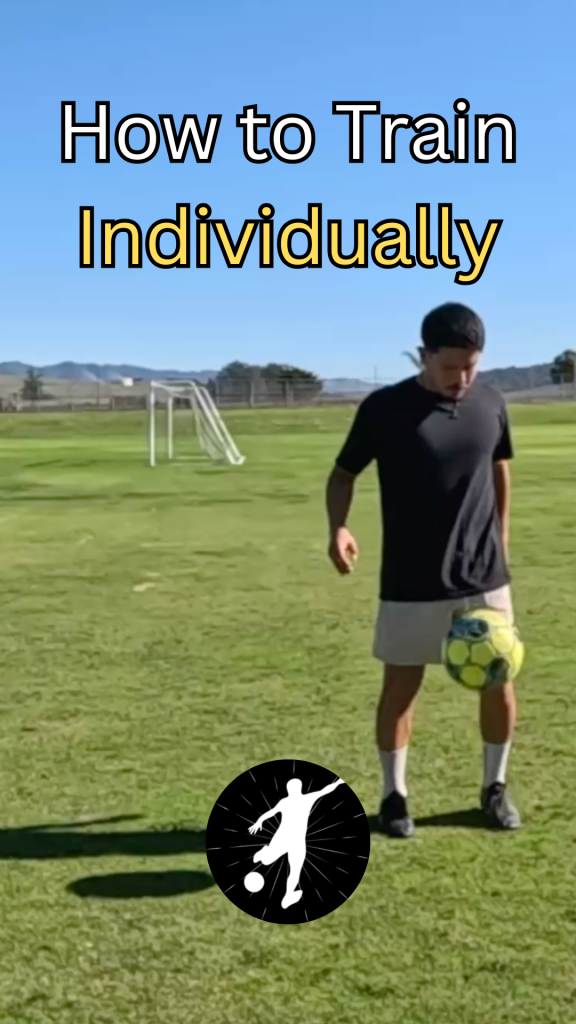
Ball Juggling
The simplest drill that every soccer player has to master is juggling the soccer ball. Although you won’t necessarily be juggling in a real game, all of the skills that you learn from juggling directly improve your game, such as first touch, passing, receiving, keeping track of the ball with your eyes, creativity, and much more.
As with the rest of the drills on this list, make sure you use both your dominant and non-dominant foot, and also challenge yourself by juggling at different heights, juggling with different parts of the foot, different parts of the body, and with different-sized training balls.
Ball Control From the Air Drill
This next soccer drill helps you improve your ball control skills. For this drill, you can start by either juggling the ball a couple of times and then hitting the ball high in the air, or simply start by kicking or throwing the ball in the air.
As the ball drops back down, the goal is to control it while keeping it as close to you as possible without letting it bounce everywhere. To make this more challenging, create a square or circle, as big or as small as you would like, and try to keep the ball under control without it leaving the grid you created.
Once you do this a few times, you can add a bit of dribbling by controlling the ball first, not letting it bounce away, and exploding into space; mix any of the following drills into this one as well.
Wall Drills- Passing
The best way to improve your passing and receiving skills individually is to find a wall or use a soccer rebounder, which acts as a training partner that never gets tired. Depending on the type of wall or rebounder that you find, you can practice different types of passes, such as one-touch passes, two-touch passes, ground passes, air passes, driven passes, or even crossing.
The goal of this drill is to challenge yourself by trying different types of passes with both feet, controlling the ball with different surfaces of your feet as it comes back to you, and hitting the ball at the wall at different speeds. For this drill, choose a pass type and foot, set a timer or count the passes, and you are ready to train.
Wall Drills- Passing + Turning
This next drill can be a progression from the previous drill. Once you have practiced only wall passing for a certain amount of time, you can progress to wall passing with turns.
For this drill, pass the ball against the wall repeatedly, and after a few passes, work on turning with the ball and dribbling into space. The point of this drill is to work both feet and to work on different types of turns, such as a half turn, the outside-of-the-foot turn, the inside-of-the-foot turn, or any other variation.
If you don’t have a wall, simply kick the ball in front of you, get to the ball, turn, and dribble past where you started.
Shadow Soccer Dribbling Drill
This next drill is similar to “shadow boxing,” except it is designed for soccer players to improve their dribbling skills. To start this drill, dribble around the open space you have available at game speed. If you have access to a full soccer field, that is best, and as you dribble down the field as fast as you can imagine, imagine defenders coming towards you trying to take the ball away.
The goal of this drill is to dribble at game speed, use different skill moves, and use your imagination to evade “defenders” coming towards you. If you are only going through the motions of dribbling, this won’t help much, which is why you have to do this at game speed, as you should with all of the drills on this list.
The more you practice dribbling at game speed while using your creativity and imagination, the easier it will become once you step onto the field in a real game. Remember, the key is to use different skill moves and get comfortable performing them at game speed.
Cone dribbling can be useful too, especially as a complete beginner, but eventually you will learn that the only way you will get better at dribbling past better players is actually going up against those players.
Shadow Soccer Dribbling Drill to Shooting
This next drill can also serve as a progression from the last two drills and must be done with maximal intent. Whether you realize it or not, no matter what position you play, one of the most important soccer skills to have is being able to shoot the soccer ball.
As an attacking player, such as a striker, winger, or CAM, shooting is a skill that must be practiced a lot, but even as a defender, such as a center back or full back, knowing how to shoot the ball is very important because improving your shooting skills will help improve other skills like passing and crossing.
To begin this drill, find a goal, and if you do not have a goal, grab two cones or any other objects and create a goal. Position yourself far from the goal and start by kicking the ball into the air or rolling it out to space.
Control the ball and dribble towards the goal with maximal intensity, and as you get closer to the goal, perform a skill move to create space for yourself, and then take a shot, aiming for the corners just as you would if there were an actual goalkeeper. Once you take a shot, reset and repeat.
For this drill, the more training balls you have, the better, because you will spend less time ball shagging, and more time training.
Maximal Intent Barefoot Sprints (With and Without the Ball)
This next drill is simple and designed to help players improve speed and agility, and you can perform it in different ways. For this drill, you can use the lines of the field, cones, or anything else to create a mark.
With this drill, you can perform maximal-intent sprints, meaning the player starts from one position and sprints as hard as they can to another, or they can perform maximal-intent shuttle runs, which will work more on agility and changing directions.
With this drill, you can also have the player sit, lie down, or start from any position besides standing to test them further and make it more challenging. The best way to get faster is to sprint as hard as you can and teach your body how to run faster.
You can do this before or after a training session. Before the training session, a player might have more energy, so they can focus more on speed; at the end of the session, they can focus more on conditioning.
You can also do this drill with and without the ball, since you will spend time sprinting with and without a ball during a real match.
Final Thoughts
These best individual soccer drills prove that you don’t need a full team or expensive equipment to improve your soccer skills – just a ball, minimal equipment, and the dedication to train consistently with both your strong and weak foot. While individual soccer training is invaluable for developing ball control, first touch, and muscle memory, remember these drills should complement team training, since soccer performance is about applying your talent consistently under pressure and making an impact.
FAQs
What are the best soccer drills for players at a younger age?
Youth soccer players who want to improve their skills should follow the same tips and drills on this list that older players use. Other drills to include are lots of 1v1, 2v2, and 3v3 games because kids want to play, and that is how they learn most at those ages. This is how kids build natural endurance, coordination, and technique, though they still need a coach to learn new skills, set targets, and progress.
What is the best way to stay consistent with mindset training in soccer?
The best way to stay consistent with mindset training in soccer is to use simple habits like journaling, visualization, and positive self-talk on a regular basis. Players can also use tools such as a soccer training journal, a performance tracker, a mental training book, and other mental training tools for soccer players to help make their mindset work more structured, consistent, and measurable.
What gear and equipment are needed to improve my soccer skills?
The best thing about soccer is that you don’t need much equipment or accessories to start playing and improving. All you really need is a soccer ball, but the more seriously you want to play, the more gear you will need, such as soccer cleats, shin guards, grip socks, shorts, and shirts, and soccer equipment, such as cones, rebounders, ball pumps, soccer bags, etc.
