


13 Reasons Why You Perform Well in Practice but Not in Soccer Games
Have you ever wondered why sometimes you dominate in soccer practice but then struggle during game day? This is a challenge many soccer players face at all levels, and the difference often comes down to the main pillars of soccer performance: talent, game IQ, athleticism, fitness, recovery, and discipline.
In training, you have time to think, make mistakes, and focus on improving your skills without pressure. But on game day, everything speeds up, decisions have to be made instantly, the stakes are higher, and the pressure to perform can change the way you play.
Understanding this gap between practice and performance is the first step to becoming a more consistent and complete player. In this blog post, I will provide an in-depth explanation of why you perform well in practice but not in games, as well as share tips that improve the pillars of performance to help you become a better player and get in better shape.
If you’re interested in taking your training to the next level with a structured program, you can reach out to me or learn more here.
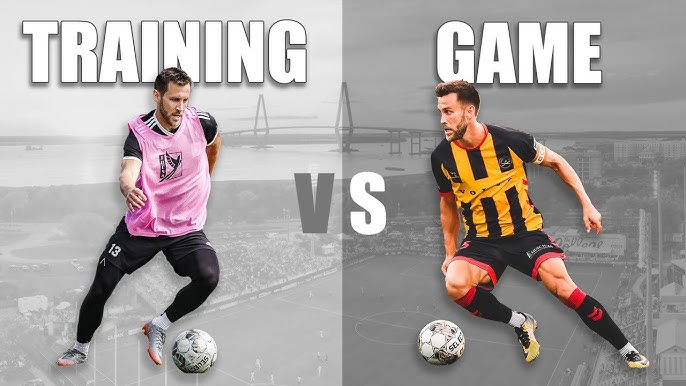
Why do some soccer players play better at training than during games?
The difference between a training session and a game comes down to the environment, the pressure of competing while the stakes are high, and with people watching. In training, you have the freedom to experiment, slow things down, and focus on learning without worrying about the impact of a mistake.
But in a real match, every action matters, your decisions impact the score, your teammates are counting on you, and mistakes can feel much more serious. Once you are in a game, you are no longer training; you are responsible for making real-time decisions that affect the outcome.
While training is essential for improvement, nothing replaces the experience and development that come from playing in real matches. These are some of the main reasons players often play better in practice than in games.
- They don’t prepare properly for competition, both on and off the field.
- They neglect proper mental and physical recovery between games.
- They spend too much time on isolated drills instead of practicing game-like scenarios.
- They don’t have strategies to manage pre-game nerves and anxiety.
- They lack mindfulness skills to stay focused on the present moment during matches.
- They allow external pressure and expectations to negatively influence their performance.
- They approach setbacks with a fixed mindset rather than viewing them as growth opportunities.
- They struggle with confidence, mental toughness, and staying composed under pressure.
- They can’t match the speed and intensity required in competitive games.
- They fear making mistakes and allow errors to cloud their decision-making.
- They become overly self-conscious about spectators and worry about being judged.
- The physicality and skill level in competition exceed what they face in practice.
- They haven’t developed strong team chemistry and struggle with team dynamics.
How do you Perform Better as a Soccer Player?
- Improve your training and preparation on and off the field
- Soccer training:
- Train with a team and/or play pickup 3-5 times a week — individual soccer drills and fun soccer drills can help 1-2 times a week, but it should not be a priority
- Mental training
- Mental toughness, growth mindset, composure, mindfulness techniques, visualization, journaling, positive self-talk
- Athletic Training
- Fitness
- Conditioning and Stamina
- Recovery
- Soccer training:
- Create routines and be consistent for long periods of time
- Training, morning, night, etc.
- Set a big goal and small goals to help you stay on track to meet your main goal
- Focus on what you can control, which includes your preparation and how you react to situations, not external factors like opinions
- Put yourself in a lot of game-like scenarios and small-sided games and avoid doing too many cone drills
- Learn to embrace mistakes and use them for development rather than fear them
- Improve team dynamics by building team chemistry
- Listen to coaches and learn from experienced players
- Watch and analyze high-level football games as well as your own games and clips
Final Thoughts
Many soccer players perform well in practice but struggle in games due to differences in pressure, environment, and the mental game. In training sessions, mistakes are part of the learning process, but in matches, the fear of failing and outside pressure can lead to hesitation and poor decision-making.
That is why, if you want to perform better during a real game, you have to focus on improving the pillars of player development by following the tips on this post consistently over a long period of time.
FAQs
Why do I play well in practice but not in games in soccer?
You likely play better in practice because the environment is less pressurized, allowing you to experiment without fear that mistakes will affect the outcome. In games, the added pressure from competition, teammates depending on you, opponents playing at higher intensity, and people watching can trigger anxiety and second-guessing.
Improving your mental game, building confidence, and practicing mindfulness techniques can help you perform consistently in both settings.
Why does practice improve performance?
Consistent practice improves performance by allowing you to develop technical skills, build fitness, and refine your soccer IQ in a controlled environment. Training gives you the repetition needed to make skills automatic and opportunities to learn from coaches and teammates.
However, combining quality training with game-like scenarios and real match experience is key to translating practice performance into match-day success.
What gear and equipment are needed to improve my soccer skills?
The best thing about soccer is that you don’t need much equipment or accessories to start playing and improving. All you really need is a soccer ball, but the more seriously you want to play, the more gear you will need, such as soccer cleats, shin guards, grip socks, shorts, and shirts, and soccer equipment, such as cones, rebounders, ball pumps, soccer bags, etc.
