

13 Best First Touch Soccer Drills To Improve Ball Control
Mastering the first touch is one of the most essential skills for any soccer player, no matter their position or playing level. Whether you’re receiving a ball on the ground, from the air, or from different distances, your first touch determines your next move and makes the difference between keeping possession of the ball and losing it.
A good first touch can help you create space and time for your next decision, while a poor first touch can lead to immediate pressure from defenders. When you watch professional players, you’ll notice their first touch always sets them up perfectly for their next pass, dribble, or shot on goal; if they take a bad touch, they either lose the ball or are forced to adapt and win it back somehow.
The best way to develop this skill is through consistent training in a team environment, experience in real games, and effective drills during extra or individual training. A good first touch matters, but it’s only effective if you develop the other fundamental skills of the game, including decision-making, awareness, composure, first touch, passing, dribbling, shooting, and defending.
Improving your first touch and the skills above will help improve your talent, which is one of the keys to player development, along with game IQ, mindset, athleticism, fitness, recovery, and discipline. That is why in this blog post, I will cover the best first-touch soccer drills to help you improve ball control, develop confidence in controlling the ball with all parts of the foot, and improve your overall passing abilities on the soccer field.
To perform the drills on this list in the most efficient way, it will be important to have some of the following training gear and accessories:
- Rebounder – To have a training partner that doesn’t get tired (or have a real training partner)
- Soccer balls – Have a few to spend less time shagging balls
- Soccer ball bags – Easy way to carry your soccer balls
- Soccer Cleats – Wear the right cleats based on your playing surface
- Portable soccer goal – Important to work on scoring goals
If you’re interested in taking your training to the next level with a structured program, you can reach out to me or learn more here.
What are The Best First Touch Soccer Drills and Exercises?
If you’re looking for ways to improve your first touch during individual training,, use the following drills, which you can do against a wall, rebounder, or training partner. For each drill, you can set a timer or count a certain number of reps.
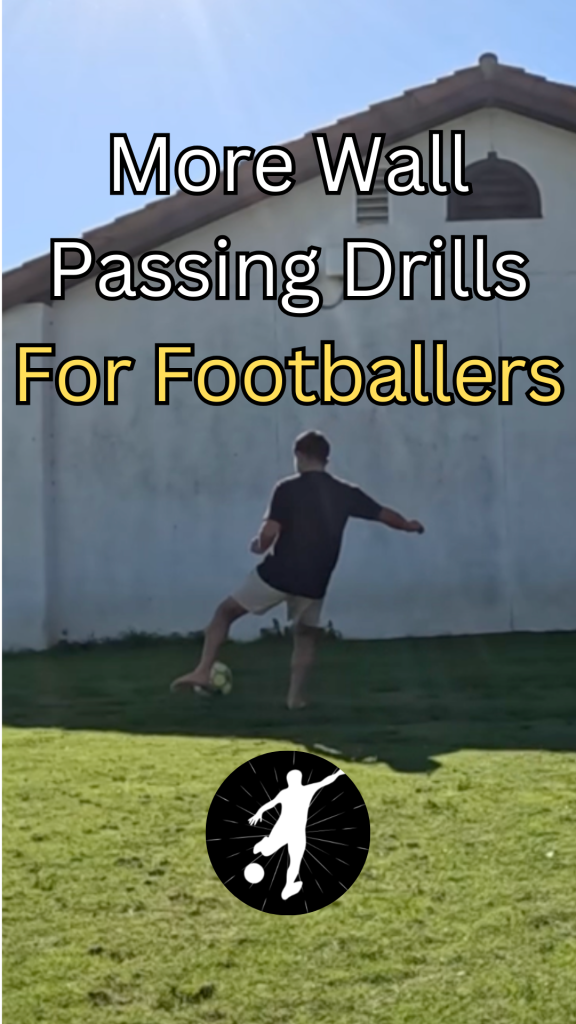
Wall Passing
For this first drill, work on simple two-touch passing: controlling with the inside of the foot, passing with the inside of the same foot, and varying between two- and one-touch passing. Focus on making the right contact with the ball every time, keeping it under control, and not letting it go anywhere.
Over time, change the angles, distance, and techniques you use to strike the ball with.
Partner Passing
Although wall passing is great, you also want to do partner passing because it adds unpredictability and variation that you can’t get from a wall. Your partner can vary the pace, height, and angle of their passes, forcing you to adapt your first touch to different types of balls, just like you would in a real game.
Juggling
For this next drill, which is also a skill in itself, you will work on keeping the ball in the air using different parts of your feet, thighs, chest, and head, without letting it drop. Start with simple foot juggling and progress to using multiple body parts, playing with height, and even learning simple freestyle tricks to build better touch and confidence.
If you have a wall, you can also practice wall juggling, or if you have a partner, you can try different juggling variations. When juggling, you can also use different-sized balls to challenge your coordination and develop more precise ball control, since smaller balls require more focus and better technique.
Directional Touch with the Inside of the Foot + Pass (2 touches)
For this drill, set up a box with four cones, or a gate with two cones, either vertically or horizontally, and place a partner or a wall about 5-10 yards away. For this drill, pass the ball to the wall and work on using the inside of your foot to control the ball past the gate.
Once it’s past the gate, repeat on the other side. You can also change the drill by taking the ball across with the inside of your foot and hitting it with the outside of that same foot.
Directional Touch with the Outside of the Foot + Pass (2 touches)
For this drill, set up exactly the same as the drill above; the only difference is that you will use the outside of the foot to control the ball, take it across the gate, and then use the inside of that same foot to pass the ball.
Directional Touch with the Sole of the Foot + Pass (2 touches)
For this drill, you will also set up exactly the same as you did for the past two drills, except this time around you will be using the sole of your foot to trap and roll the ball past the gate before you make a firm pass on the ground to the wall or your partner
Check out One Touch Passing with the Inside of the Foot
For these next drills,, we’re going to work on one-touch passing, but like in a game, we’re going to add an agility movement beforehand. You can set up any type of sprint out to a cone and perform a one-touch pass with the inside of your foot to the wall or to your partner.
Check out One Touch Passing with the Outside of the Foot
The setup for this next drill is the same as above, except the one-touch pass now has to be done with the outside of your foot. This will force you to work on a skill known as the “trivela,” which you can use to pass, cross, or even shoot the ball.
One Touch Chip Pass
For this drill, you’ll practice chipping the ball over an imaginary defender or obstacle using just one touch when the ball comes to you from your partner or wall. Focus on getting under the ball with a firm but controlled touch, using the inside of your foot to create the loft needed to clear a defender and reach your target.
One Touch Volley Pass
Set yourself up about 8-10 yards from a wall or partner and volley the ball back and forth in one touch. This drill improves your ability to handle balls that come at speed or from the air, which is crucial when receiving crosses or long passes during games.
Receiving the ball from the air
For this exercise, have your partner throw or kick balls to you at various heights, some at chest level, others at head height, and some bouncing balls. Practice controlling the ball in different ways, such as with your feet, chest, or thigh, setting you up for your next move, and without letting the ball go everywhere.
One Touch Turn and Play
Position yourself with your back to the wall or your partner, then receive the ball and use one touch to turn 180 degrees while immediately playing the ball forward. This drill builds the quick decision-making and body movement you need when receiving the ball under pressure from behind in real game situations.
Vitamins
This high-intensity drill involves rapid-fire passing between you and a partner or wall after an agility-focused exercise, then focusing on quick one- and two-touch combinations. For example, place a few hurdles on the floor, do some quick feet and high knees over the hurdles facing one way, and once you get to the end, have a partner throw or pass a ball at you, which you will pass back to them either in the air or on the ground.
Final Thoughts
To summarize, these 13 first-touch soccer drills will transform your ball control from average to exceptional, giving you the confidence to receive any pass and turn it into an opportunity during real games. Remember to practice consistently with both feet, focus on quality touches over speed, and gradually increase the difficulty as your first touch improves.
The time you invest in these drills during extra individual training will translate directly into better possession, more space creation, and improved decision-making on the soccer field.
FAQs
What skills does first touch develop?
First touch training develops ball control, spatial awareness, and the ability to receive passes under pressure while maintaining possession. It also improves your decision-making speed, body positioning, and confidence when handling difficult balls, which directly translates to better performance during real games.
What are the best soccer recovery options for players?
The best soccer recovery options for players include high-quality soccer recovery equipment, effective injury prevention tools, and structured habits built through following consistent routines, from training routines and daily routines to morning routines that support performance and longevity. It is also important for players to invest in off-field recovery tools and in-game protective gear, such as compression gear, shin guards, supportive footwear like barefoot shoes, extra recovery accessories such as EMF protection for soccer players, and foundational support from soccer supplements to help the body recover, adapt, and stay resilient throughout the season.
What gear and equipment are needed to improve my soccer skills?
The best thing about soccer is that you don’t need much equipment or accessories to start playing and improving. All you really need is a soccer ball, but the more seriously you want to play, the more gear you will need, such as soccer cleats, shin guards, grip socks, shorts, and shirts, and soccer equipment, such as cones, rebounders, ball pumps, soccer bags, etc.
