


9 Best Soccer Assessments for Individual Skill Development
You’re putting in countless hours on the soccer field, but are you actually improving as a player? Without proper assessments and a plan to follow, you may train without thinking, unable to identify weaknesses, track progress, or reach your full potential.
Assessments are an important part of any soccer player’s development and help players, coaches, and parents evaluate ball skills. There are other important fitness tests and conditioning drills for soccer players that don’t include a ball, and if you want to learn more about those, you can check out this blog.
Improving as a soccer player comes down to developing the key pillars of player development: talent, game IQ, mindset, athleticism, fitness, recovery, and discipline, all of which play a role in helping you perform at a higher level and reach your full potential. Remember, the best ways to improve at soccer include playing as much as possible through team training sessions, league games, or pickup games.
However, structured assessments allow you to train smarter by pinpointing exactly which technical skills need the most work, which you can then use solo soccer drills to improve during individual training sessions. In this blog post, I’ll cover nine assessments that test some of the most fundamental skills of the game: decision-making, awareness, composure, first touch, juggling, passing, dribbling, shooting, and defending.
If you’re interested in taking your training to the next level with a structured program, you can reach out to me or learn more here.
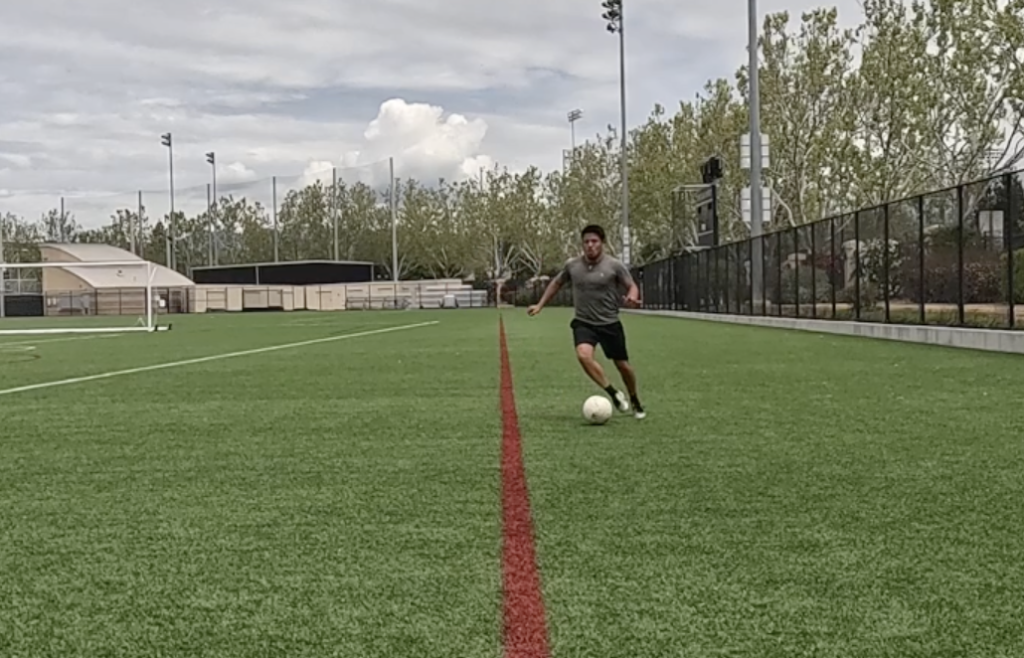
What are the best soccer skills to track for improvement?
One Foot Balance + Juggling
This first assessment will focus on the fundamental skills of juggling and balance. The goal here is to maintain balance and full control of your body and the ball while juggling the ball below your knees.
To see how to perform this assessment, watch this video of Cristiano Ronaldo doing it himself.
Controlling the Ball from High in the Air
This assessment is for your first touch and ability to control a ball coming from above, which is very important, no matter what position you play. To perform this test, stand inside a 5-yard square or circle grid and toss the ball high in the air over your head, then control it with your chest, thigh, or foot before it bounces more than once on the ground.
You can also kick the ball up, but try to kick it around the same height every time and count how many successful first-touch controls you can complete out of a set number, such as 10 or 20.
Alternate Juggling with High Kicks
This test builds on the foundation of juggling, and it is also designed to test your ball control with both feet, but in a different way. With this assessment, create a 5-yard square or circle grid, juggle the ball a few times, and then kick the ball in the air high above your head.
See how many times you are able to control the ball in the air and try to kick the ball at a consistent height. Once you reach a minimum of 100 juggles, you have passed this test.
Wall Passes
One way to test your passing is to find a wall or a soccer rebounder, set a one- to two-minute timer, and count how many successful passes you can complete while maintaining control of the ball. To make this trackable, perform wall passes with your right foot only, left foot only, and then alternating feet, and count only the passes where the ball comes back to you cleanly without losing control.
For this one, it’s more of a visual assessment; over time, you will look smoother and more confident with your touch and passing.
Freestyle Dribbling for 45 Seconds to 1 Minute
This assessment is more of a visual test to see how effortlessly you dribble, control, and stay creative with the ball at your feet. For this assessment, grab a soccer ball and create a grid as big as you’d like, or use any open space you have available.
Set up a 1-minute timer and dribble inside the box while doing different skill moves along the way, just like a boxer performs “shadow-boxing”; think of this as “shadow-dribbling.” Same as above, this will be more of a visual assessment; over time, you will hopefully look smoother and more confident with your touch and passing.
Freestyle Dribbling to Shooting
For this next assessment, we are combining dribbling with shooting accuracy. Similar to the last assessment, grab a soccer ball (the more you have available, the better), start a few yards away from the 18-yard box, and set a 2-minute timer.
Kick the ball in the air and control it, or roll the ball out, and perform “shadow dribbling” until you get closer to the goal, where you will then perform a skill move, create space for yourself, and take a shot at the goal. Make sure to go at a high intensity, like it’s a game; push yourself and see how many you can score.
Sprint Tests at 10, 20, 30m with the ball:
Sprinting with the ball is one of the most important actions in soccer, making this test essential for evaluating your acceleration, explosiveness, and ability to maintain control at high speeds. Place three cones 10 meters apart at the 10m, 20m, and 30m marks, then dribble at maximum speed through each marker while keeping the ball close using quick touches or longer pushes depending on your technique.
Record yourself and review the footage, or have someone time each split to track your speed with the ball compared to without it.
505 Change of Direction with the ball:
The 505 Change of Direction test adds to the sprint test above by evaluating your ability to decelerate, turn sharply, and re-accelerate while maintaining ball control. These skills are crucial when you need to beat defenders or evade pressure in tight spaces. Set up a gate at 5 meters and a cone at 10 meters. Start with the ball at your feet, sprint through the gate (timer starts), dribble to the 10m cone, perform a sharp turn using your preferred technique, and sprint back through the gate to stop the timer.
This assessment shows how efficiently you can change direction at speed without losing possession, directly measuring one of the most game-critical skills in soccer, no matter your position.
T-Test with the ball:
The T-Test is another agility test that you can do with a ball that is set up in a T shape and requires players to start at the bottom of the T, sprint towards the top, sole roll the ball to the right or left, reach the end, sole roll back across to the opposite end, and then return to the center before backpedaling + toe tapping back to the starting point.
Final Thoughts
Soccer skills assessments give you a clear, measurable way to track your technical development and identify which areas of your game need the most attention. By regularly testing yourself on fundamental skills like the ones on this list, you create accountability in your training routine and make sure the hours you’re putting in translate into improvement on the field.
Whether you’re training alone, with a coach, or as part of a team, these assessments give you the data you need to set realistic goals, track progress over time, and build the complete skill set required to compete at higher levels of the game. Just remember that although it is important to improve at these skill tests, it is even more important to play regularly against high-level players in competitive situations because this is where you’ll truly learn to apply your improved technical abilities under pressure, make better decisions, and develop the game intelligence that separates good players from great ones.
FAQs
What is the best aerobic fitness test for soccer players’ performance?
The best aerobic fitness test for soccer players is the beep test (also known as the yo-yo test), which measures a player’s ability to run at high intensity with short recovery periods. This test consists of running back and forth between markers at increasing speeds until exhaustion, simulating the aerobic demands of a match.
How do you assess youth soccer players and professional soccer players?
You can assess both youth and professional soccer players using the same fundamental tests, though benchmarks and expectations will differ by age and skill level. Assessments should evaluate various aspects of performance, including physical fitness, technical skills like ball control and shooting accuracy, and physical abilities such as speed and agility.
The key is to provide valuable information and feedback that helps coaches and players make informed decisions about player development and training focus areas, regardless of whether you’re working with young athletes or professional football players.
What is the best training equipment to perform soccer assessments?
The best training gear and equipment for performing soccer skill assessments properly includes soccer balls, soccer ball bags, soccer ball pumps, soccer cleats, cones, a wall or soccer rebounder, a soccer goal, a soccer camera, and a soccer tracker. It is also important to have other accessories like a soccer bag, high-quality insoles, grip socks, and compression gear to enhance your comfort, maintain peak performance, and support recovery between training sessions.
